
Weekend Reading – Should you buy the dip?
Hey Everyone,
Welcome to some new Weekend Reading, wondering: should you buy the dip?
Before my answer, here is my most recent post about navigating the recent market smackdown!
Weekend Reading – Should you buy the dip?
Yes.
Let me explain.
As we all know by now, the financial industry loves clichés…
With investing you usually get what you don’t pay for.
In the financial markets, people often sabotage their portfolios out of sheer boredom.
And so on.
One phrase you’ve probably also heard of when stocks tank or correct is a call to action to: “buy the dip”.
Catchy, yes.
Smart too!
Inspiration for this post came from Ben Carlson – A Wealth of Common Sense this week.
He: “…looked back at the end of every month the S&P 500 was in a 15% peak-to-trough drawdown or worse since 1950. Then I looked at the forward 1, 3, 5 and 10 year total returns from there.”
Here is what he found:
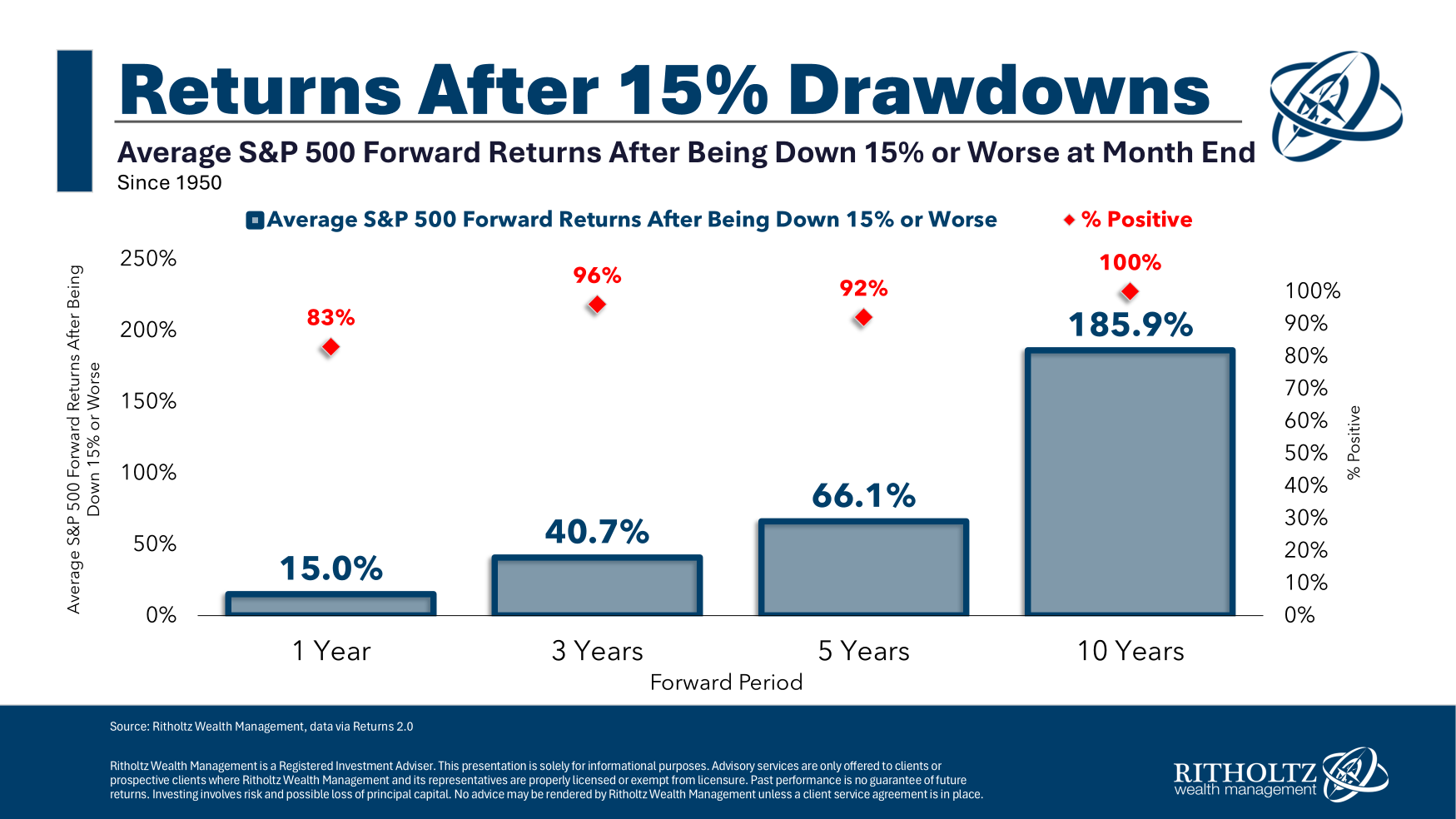
“….most of the time buying when the stock market is down double digits tends to work out for long-term investors.”
Indeed.
In this post on my site, I found the following when it comes to how often stocks go up from the Canadian context.
That’s a lot of growth you could be missing out on – if you don’t “buy the dip” and remain invested.
Remember, the returns you get (eventually, over time) from owning a collection of stocks tends to be the price you pay for near-term volatility; as painful as those market smackdowns may be.
My own “buy the dip” example occurred just this month.
When I saw one of my favourite low-cost ETFs that I own (XAW) dip in price (going down more than 10% is my target; under $40 after it started the year north of $44) I bought the dip.

Source: Google Finance
There are some positive outcomes when you “buy the dip”:
- You are buying your favourite low-cost ETFs or stocks on sale at cheaper prices even if you never get the perfect bottom price. (I don’t care about perfect timing anyhow.)
- You can put idle cash to work since cash is likely to be a loser to long-term inflation and stocks typically are great inflation fighters.
Accepting you and I cannot perfectly time the market even if we tried, a decent enough approach is to “buy the dip” when your desired equities drop more than 10% in value. That has been a reasonable approach for me.
It has been said when you invest, you are buying a day you don’t have to work.
I’ve always felt it was best to get my money working for me, when I have it, available to invest. I’ve followed this approach for about 20+ years now. So far, so good – we’ve built a seven-figure investment portfolio to start semi-retirement with.
In a link below, you will find that DCA (Dollar-Cost Averaging) investing approaches can also work very well over time too – investing fixed amounts over fixed intervals.
Just remember with any equity investing approach you choose:
Owning stocks can be risky in the short term. Not owning stocks will be risky in the long term.
More Weekend Reading – Should you buy the dip?
Related to this subject, I wrote about DCA and LSI here:
Also related to this, The Globe and Mail highlighted there can be problems with buying the dip (subscription) – unless of course you are now shopping for some Canadian equities.
“From a valuation standpoint, it is hard to argue that stocks are unusually attractive,” Gabriel Dechaine, an analyst at National Bank of Canada, said in an April 6 note…
After 15 years of blogging, I still love helping others navigate their investing path and running this site.
In this podcast with Vero from @DividendGuy, I shared my saving and investing journey from paper routes (remember those??) to FIWOOT today (Financial Independence, Work On Own Terms).
🎙️ Have a listen!!! thedividendguyblog.com/213
Reaching FIWOOT with Dividends – Mark from My Own Advisor [Podcast]
A good read here from Morningstar, about the potential fate of our Canadian dollar.
A nice summary from Dividend Growth Investor on his retirement income strategy. Some quotable items from his list that I know would appeal to many of my readers:
“If the economy is doing great, businesses will be earning more and paying higher dividends. I may even generate more in dividends than I need.
If the economy is doing terribly, and we get a once in a generation depression that knocks down profits, to the point like dividends are lowered en masse, I will curtail my spending to the amount of dividends received. That flexibility, and adaptability to the current environment, versus relying on a bulky academic model, is really appealing to me.
I love the idea of living off the returns generated today, not the historical or theoretical returns we read about in a study.”
A thank you to Rob Carrick @rcarrick from The Globe and Mail for mentioning this post below in his popular Carrick on Money newsletter.
These are some big investing and semi-retirement mistakes I hope to avoid.
How many have you avoided?
Save, Invest, Prosper!
Want to your own personalized low-cost retirement income projections?
Just reach out!
Check out my work along with my partner Joe at Cashflows & Portfolios.

My partner and I have been using various retirement projection tools over the years for our personal retirement income journeys and now we’re using these tools to help readers, like you, with your personal retirement projections. We’ve answered these questions for our own semi-retirement plans and we can answer these for you too:
- Do you have enough to retire to fund your desired lifestyle/spending?
- Amongst any pension income, RRSPs, TFSAs or taxable accounts which account should you drawdown first and in doing so, what are the taxation implications?
- Should you take CPP or OAS at age 65 or 70?
- And more!
Again, contact us anytime to learn more and get started.
All My Own Advisor readers get an automatic discount on these services. Just ask. You ask, you get a discount. That simple. 🙂
Pretty nice recent testimonial…if I don’t say…
“Cashflows and Portfolios provides exceptional value for DIY investors. Their free content is a fantastic starting point, offering a wealth of knowledge. When I needed more personalized support, their low-cost financial projection service was exactly what I was looking for. It was incredibly helpful to get tailored insights from fellow DIY investors. I highly recommend both their free resources and their personalized services!”
Have a great weekend!
Mark


Mark, what a timely topic you raised. I wish I have more cash to buy on the dip!!! I added a small position on a gold stock Luca Mining (LUCA.V) recently. Time will tell if I made the wise decision.
Happy Easter to you and everyone.
Good stuff. Yes, decisions can be great or not-so-great in hindsight! We’ve all been there. I am just adding to XAW inside registered accounts if/when I have the money to do so. Boring but it works. 🙂
Happy Easter to you and your family as well.
Mark
If I was 20 years younger I’d be seriously considering adding to the equity positions in the portfolio. But now, I just don’t see any reason to. Maybe if prices substantially fall some more? Don’t know. For now, if the market falls due to weird times we are in, the non-equity portion should be fine and may present an opportunity one just can’t say no to. If for some reason markets rise, the equity portion will ride the tide. It’s selfish but we are okay. I REALLY feel for the youngsters trying to weather this though. They’re the ones that are really behind the 8-ball.
If you’ve won the game per se, Lloyd – why bother?
I have purchased a bit of low-cost ETF XAW this past month and will report that in my next dividend income update. I have yet to do the final tally but I am optimistic it could be over $50k this calendar year.
https://www.myownadvisor.ca/march-2025-dividend-income-update/
Younger investors just need to focus on their saving rate for investing and buying as much as they can. Same formula that has worked for a few generations.
Thoughts?
Mark
Sure, invest if they have the financial capability but wow, how do they do that with everything going the way it’s going? I’d not want to be starting out now.
Hitting $50K would be a great milestone. Good on you! Sure it may be just a number, but it sure feels good hitting them from time to time.
I spent an hour this weekend modifying my spreadsheet because of the XEI distribution. Had to incorporate an averaging formula to the forward annual income while leaving the monthly calculation. It’s always been an issue I mentally took into account but this increase just skewed the annual amount too much. I don’t know why they can’t smooth it out better rather than have the quarterly payments jump around so much.
Ya, here’s hoping on the $50k soon!!
Ya, XEI doesn’t have steady distributions but not a big deal. You have other great income sources I recall.
I own 8 of the top-10 holdings in XEI.
Mark
“Ya, XEI doesn’t have steady distributions but not a big deal.”
🙂
Admittedly that was pretty petty of me. Good to keep some perspective.
Well, you’re doing just fine.
You are getting your 4% yield + give or take 3% growth over time from XEI. That’s very good. I’ll take 7% annualized for the coming 30-40 years. 🙂
Mark
Great article. My setup is quite similar to yours: XAW and QQC (or QQC) as a tech kicker, and a core div portfolio. The main difference is I have Canadian div ETFs, as well as International div ETFs, like SCHD, XDG, VIDY, etc
Anyways, having a plan to buy dips is key, and really buys should increase as the price of an ETF falls. For example, $x at 10%, $x + $2k at 15%, etc. Ideally, the buys should increase exponentially. For example, $x at a 10% drop, $2x at a 15% drop, $4x at a 20% drop, etc. Of course, it’s very easy to miss the bottom this way due to lack of cash, as, even with low initial buys, they increase rapidly. Anyways, having a plan to buy the dips is essential imo.
Good stuff, Sal.
I won’t rule out owning some XIU or something similar as I get older to go with XAW but for now, it’s largely XAW as my top-holding + a bunch of Canadian stocks (25 or so) for most my portfolio. QQQ and HEQT as equity ETFs are smallish portions in registered accounts.
Buying anything lately/during these times even if you miss the bottom per se?
Mark
Thanks for the reply Mark! I did buy some XAW, QQC, XEI, SCHD and VIDY as they all fell over 10%.
Great stuff, Sal.
I don’t own XEI but I like the holdings and own most of the top-15 directly as stocks.
I own lots of XAW and it’s great for global-growth since Canada only makes up 3% of the world market.
QQC is an easy one to see why you own it. I have QQQ. 🙂
SCHD in particular seems great for income and growth. I read about a lot of DIY investors owning that one.
I know of VIDY and the latter, XDG for global dividends but don’t own either. I get my global fix from mostly XAW in my portfolio although I have some HEQT in my LIRA.
https://www.myownadvisor.ca/then-and-now-managing-my-lira/
“My LIRA today is now composed of mostly HEQT, some QQQ and some CBIL.” I will use CBIL to fund my withdrawals in the first 2-3 years; ready to roll. 🙂
Mark
Great subject , I’ve been investing my dividends on the 16th of the month on all 6 of my accounts . The only caveat I have is there must be $1000 to invest . I choose 1 stock in each account , this form of Dollar cost averaging has worked well for many years . Thanks again Mark .
Good stuff, JP.
Ya, similar, I won’t buy anything if I don’t have at least $1k or ideally $2k+ to make it worth my while.
Buying anything lately?
Mark
I believe I will be buying CNQ there yield is at 6% . Will add on all my accounts .
Love that company. Own a bunch!
Hi Mark,
I just tend to keep things simple in investing.
Once a year in January my wife and I add to XDG in the TFSA’s.
Once a month we add to one of the Canadian dividend stocks shown to be lagging in our spreadsheet for the non-registered account.
Not anymore difficult for me than running an indexed portfolio. I purposely constructed it that way.
Wishing you and your family a happy Easter weekend.
XDG – nice.
Have you been investing in that some time?
XAW is my go-to for long-term growh as you know. Not sure XAW will keep up the 10% returns it has delivered over the last 10-years but even if it delivers 5-6% I am “good” since that is part of my long-term projections.
Wishing you a great Easter weekend back.
Thanks for your comments,
Mark
We originally had ZBAL in the TFSA’s, but sold it in Feb 2023, to replace with XDG that same month.
It’s still all ZBAL in the RRIF’s.
Thanks again Mark. Always something interesting here at your website to read.
Good stuff. My parents have VGRO in their TFSAs for growth – they won’t be touching those assets for about 5 years or so.
I have some Canadian banks, some pipelines and lots of XAW in my TFSA for growth. I will likely keep it that way for many years to come = mix of income from stocks I own (if I need it?) + global growth in XAW.
https://www.myownadvisor.ca/whats-in-your-tfsa/
I actually put my parents into VBAL for their RRIFs for potentially the same reason you own ZBAL – they just sell a bit of VBAL every 2-3 years, move the proceeds to cash/cash equivalents, and then withdraw the cash/cash equivalents each January based on RRIF forced withdrawals.
XDG seems like a nice, lazy way, to get returns in your TFSA. You have 100% of your TFSAs (x2?) invested in that now?
Mark
The TFSA’s are mostly in XDG but we still have a separate HISA in another financial institution from the early years when TFSA’s were first made available to the public in 2009.
Gotcha. 🙂
Hi Mark – just finished listening to your Dividend Guy podcast. Great job as always! I love how consistent your messaging is – logical, thoughtful and and well articulated. Will continue to look for these interesting conversations on your FIWOOT journey!
Thanks very much, MikeyP!
Always fun to do those things. I will have a TD Bank / TD Direct Investing webinar coming up. Stay tuned. 🙂
Mark