
Weekend Reading – Sequence of Returns Risk
Hey Folks!
Welcome to some new Weekend Reading about sequence of returns risk.
This subject is essential to understand if you are considering semi-retirement like I am or full-retirement at any age.
I’ll highlight a few considerations as part of this edition thanks to a recent reader email instead of my usual links/updates.
First up, a recent read on my site – a new income milestone was realized in 2024! Whoot!
Sequence of Returns Risk
There is already so much on this subject (more at the end) but I’ll summarize the challenges and mitigations I personally see in combating some sequence of returns risks in this edition – including what I intend to do.
I welcome your comments and thoughts as always…
OK, to start, investing can work both ways:
- You retire, markets go up for a few years during retirement.
- You retire, markets go down for a few years during retirement.
The former is easy, right?
Everyone can live with 7-10% returns year-after-year.
At least they should. 🙂
The greatest investor of our time is happy with 7-10% returns so you and I need to be as well.
The problem is, while stock markets do go up about 70% of the time, sometimes they go down – and they can go down and stay down for a bit too.
Experienced investors don’t need tons of charts to tell you this is true. Check out the link above for the data and research if you haven’t experienced a major market meltdown yet.
Timing in life and with your retirement income plan – matters
I don’t have 100% cash in my portfolio and I bet you don’t either. Since a retirement portfolio is not just cash savings alone, you can appreciate that if your portfolio drops a lot in value, while you are taking money of your the portfolio at the same time, that can scramble your retirement income plan and leave you with less money to spend as you age.
For anyone drawing down their portfolio in retirement, I believe a bad set of market returns can be a admirable foe to fight.
Any portfolio down in value, without a cash wedge as just one mitigation tactic, will be a double-whammy if you consider inflation:
- You are forced to withdraw from your portfolio when asset values are down, and/or
- You are forced to withdraw from your portfolio when inflation could be higher – eating into any purchasing power.
(#1 is bad enough but when combined with #2 it can be disastrous.)
In your asset decumulation years, timing is everything. If the market is down and you must drawdown your retirement assets the longevity of your portfolio might be in question.
Consider this: if the initial returns are positive after you retire it’s clear sailing: capital can grow and yes all of us including Warren Buffett can live with ~ 10% returns.
But an investor who experiences a series of negative early returns in retirement must confront at least two issues if not three:
- capital must be sold for income needs,
- the smaller capital account that remains will compound less, and depending on inflation,
- you have less aforementioned purchasing power.
Let’s look at an example using two different worst-case 10-year market scenarios.
Under both scenarios, the returns are identical, except in reverse order.
Take notice of the negative returns in years 1 and 2 at the start of retirement in Scenario B.
Under scenario B, even though the average returns are the same as Scenario A over time, the portfolio for Scenario B lasts 5 years less.
Check out this great, detailed post on managing sequence of returns risk in retirement including a case study.
However, it’s not all doom and gloom.
5 ways in which I will protect myself (and you can too)!
Like I mentioned above, if you develop a cash wedge as one key tactic for your retirement needs you can better navigate market volatility, in a very simple way. This cash wedge won’t cost much although there could be some opportunity costs (i.e., lower returns from cash/cash equivalents than common stocks over time).
Yet the cash wedge will help you preserve some capital to rebound during any market downturn, and help you stick to the long-term plan you’ve been building all along.
So, beyond some cash/cash equivalents that I’ll list below as one mitigation tactic, how do you protect yourself in the event you experience a poor series of investing returns like Scenario B above?
1. Practice portfolio diversification and rebalacing.
From the successful retirees I know, follow, and have learned from, most of them do not have 100% of their porfolios in stocks. Successful retirees at least consider some bonds or some bonds via a balanced 60/40 all-in-one ETF. This of course depends on their income streams. Bonds are like parachutes for a stock portfolio – they cushion the blow when stocks fall in price. Also, when taking your income from a portfolio for retirement living expenses, you can consider rebalancing your portfolio at the same time.
Thanks to A Wealth of Common Sense for this example:
“Let’s assume instead of pulling money from both stocks and bonds in their 60/40 proportions (as we did in the last example), instead you intelligently rebalance based on the performance of each asset class.
In a relatively good year for the stock market, you take your distribution from stocks, and in a relatively good year for bonds, you take your distribution from bonds.
Now you ended up with almost $1.3 million by 2020, having still spent more than $1 million.1″
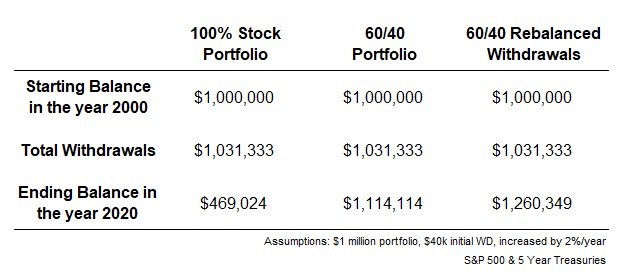
This is also a good time to remind you that if you intend to “live off dividends” a bit like I intend to do in early retirement/semi-retirement, then you cannot eliminate the sequence risk entirely.
Why?
While yes, if you just spend the dividends then you’re not selling anything…..the dividends don’t fall from the sky. So, spending dividends is functionally equivalent to NOT getting any dividends in the first place and then selling shares in that amount.

Source: HonestMath.
2. Take CPP and OAS early / take government benefits at a traditional retirement age.
I’m a huge fan of deferring CPP and OAS benefits into later in life (for the highest, gurananteed, inflation-protected income to be gained via these government benefits) but the flipside is, by taking either Canada Pension Plan or Old Age Security, or both, as soon as you can – you can mitigate the impacts to your personal portfolio.
With this guaranteed income flowing to you, earlier in life / right at the time of retirement, you’re earning steady government income. Bad stock market timing, mistakes made related to personal portfolio withdrawals from your RRSPs/RRIFs for example are buffered.
3. Use a Variable Percentage Withdrawal (VPW) Approach.
Like CPP and OAS deferrals, I’m also a huge fan of using VPW – I’m very likely to employ part of this for my retirement income planning.
I previously wrote about VPW here, but this is the Coles Notes version. This approach works because:
- It combines the best ideas associated with constant-dollar withdrawal and constant-percentage withdrawal strategies (e.g., the 4% rule).
- It adapts your withdrawals to market/portfolio returns so effectively you don’t drawdown your portfolio too quickly.
- It uses a variable, and an increasing percentage to determine withdrawals so effectively you don’t hoard your money “until the end”. Spending is always variable and not linear.
- This is one of the best approaches I’ve seen that allow you to essentially:
- increase your spending in “good years” and,
- decrease your spending in “bad years” therefore giving investors psychological ease.
Here are some free retirement tools related to VPW.
4. Scale back.
Maybe not your favourite, not mine either!
But, this is a tactic! If you don’t have some of these other options available to you, you simply may want to consider dialing down retirement income spending at any age. Basically, anything you can do to avoid selling investments when the market is down could potentially benefit your portfolio in the months or years ahead. Scaling back means putting off major expenes for a period of time.
5. Use the cash wedge / establish a cash buffer.
This is the cornerstone of our retirement income plan to curb any sequence of returns risk.
Whether you decide to build your cash wedge now (to help you in your asset accumulation years), or later, as you enter semi-retirement or retirement, I believe it’s an important approach to consider to navigate uncertain market waters that will always persist.
In my asset accumulation years, our cash position was really a high-interest savings account emergency fund.
Now, it’s much more.
In your asset decumulation years, a typical cash wedge construction could be:
- Year 1 – a year (or so) of expenses in cash and/or in a combination of cash and a money market fund that is highly accessible. This is the bucket where you draw your retirement income from.
- Years 2 and 3 – this is a portion of your retirement portfolio that is allocated into short-term investments, such as a 1- or 2-year Guaranteed Investment Certificate (GIC), some bonds or some fixed-income funds. On maturity when using GICs in this example, these investments are used to replenish your cash wedge (Year 1).
- Years 4+ – the rest of your portfolio is left to grow, as a diversified equity portfolio, providing growth for future years. Hopefully by years 4 or even 5, the equity markets have rebounded a bit as you sell some of this portfolio to feed your near-term spending.
Check out this post about various Cash Wedge construction approaches here.
I’ve included a good visual for you below:

You can download this simple 1-pager for your reference too!
We’re planning to keep at least 1-years’ worth of expenses in cash/cash equivalents entering semi-retirement now.
Semi-retirement means I will still work just not full-time.
In full retirement, not working at all for any income, I’m very likely to own some GICs in my corporation and/or more cash ETFs, more money market funds in our RRSPs/RRIFs, LIRAs/LIFs specifically to cover MUCH more than 1-years’ worth of expenses; potentially 2 years’ worth.
I’ll keep you posted when I’m no longer working at all…but that won’t happen right away. 🙂
Weekend Reading – Sequence of Returns Risk
Early retirees, DIY investors like myself striving for semi-retirement and even individuals seeking to retire at more traditional ages of age 65, face sequence of returns risk issues.
However, you have the following options to leverage:
- Manage a balanced portfolio in retirement – since stocks and bonds should counteract.
- Consider taking CPP and OAS early if you need to – to reduce personal portfolio/RRSP withdrawals and those impacts.
- Follow VPW – spend more in good years, spend a bit less in bad stock market years.
- Have the ability to scale back discretionary spending – defer major spending where possible.
- Set-up and maintain a cash wedge – keep at least 1-year in place (if not multiple years?) since cash/cash equivalents can be withdrawn from in bad stock market years.
I will be using a combination of #3 and #5 specifically, and I will consider other options above as needed to navigate any sequence of returns risk.
I want to thank my reader for his question and an opportunity to frame this content as part of our own retirement income planning.
I have more reader questions in my inbox since the new year and I’ll try and get to those in the coming weeks. Keep them coming!
Lastly, I encourage all readers, retirees, and asset accumulators alike to share their thoughts on this post. I welcome your contributions for ongoing learning on this free site to everyone.
Have a great weekend!
Mark
Closing thoughts – when it comes to investing:
“Good markets and bad markets never last forever,
Bad markets can and do happen which can be painful, but
Good markets usually prevail over investing time.” – My Own Advisor.
Related Reading / Deep Dives:
On the other side of the spectrum, for extensive details, check out Dr. Karsten Jeske (aka Big ERN, from the U.S.) from the Early Retirement Now blog who goes into multiple rabbit holes in this 50+ part series: The Safe Withdrawal Rate Series. Big ERN concludes in most of these posts, that any safe withdrawal rate starting out in retirement is usually somewhere in the 3.25%-3.5% range. He’s put hundreds of hours into this series – check it out if you want to dive as deep as possible into withdrawal rates and sequence of returns risks. Hope all is well, Karsten.

I think I’m aligned with those that will be relying on dividend income. I don’t worry too much about sequence of returns risk, other than our RIFs. In year one (age 60 for me), dividends in our RIF will only cover about half the expected withdrawal from our RIFs in dividends, so there is some sequence risk for sure. RIF income stream is about 1/3 of the total (so, about 1/6th of income is subject to sequence of returns risk). I think we will be okay. If the RIFs run out sooner than the 10 year run we plan then we can make some budgetary changes.
Also, about six months before we retire we will turn off the DRIP on most of our holdings to begin building a pile of cash. That will likely be the extent of our cash wedge.
I hear ya, James.
The benefits I see with a focus on dividend and distribution income, is of course, the company or ETF sends you the money vs. you making your own dividends. Psychologically, might be easier this way!
Keep me posted on your plans – I also see the benefits of “turning off” all DRIPs to get cash paid vs. reinvesting in retirement but an exception for me is keeping DRIPs on inside the TFSA since I don’t intend to touch it at all…for a few decades.
Cheers,
Mark
Yes, I agree completely with not turning off the DRIPs in our TFSAs. We tend to envision our TFSAs as available to fill any shortfalls in our cash flow. In both my “with debt” model and “without debt” model we use them to bridge some small income gaps in the first 10-15 years, but otherwise let them grow un-touched to the extent possible. It’ll be mostly in our non-registered account where I will turn off the DRIP in advance of actual retirement. We have to pay tax on those dividends no matter what, so might as well get them ready to be used. I assume I’ll do a monthly transfer into a HISA or something like that while the cash is building.
Not sure where I’ll end up with the RSP/RIF accounts. The plan is take the minimum withdrawal from RIFs early in the calendar year to get some cash while avoiding withholding tax, then take whatever else we need to fund the following year (including TFSA contributions) as close to Dec 31st as possible (however the minimum only represents about 30% of the total anticipated RIF withdrawals – so some planning still to be done here). I’m expecting an average tax rate of 7-12% so avoiding withholdings taxes (for a lengthy period) is an objective, buy maybe one I fuss about too much.
Hard to say what I’ll do with the DRIP in the RSP/RIF accounts given we’re only expecting to utilize income streams from them for the first 10 years of retirement.
I’m retired, and although we’re not touching our TFSA funds at this time, or for the foreseeable future, I turned off the DRIPs to use the dividends to re-balance quarterly; it gives me something to do 🙂
Ha! Good point Bob – I could see myself taking the same approach!
Thanks, Bob – I think keeping TFSAs intact for many years, unless you need it for a major capital outlays, where possible for both income planning and estate planning.
Ya, I think it makes sense for estate planning, longevity risk, to keep TFSAs largely intact for some time during retirement. Again, for the most part. I like DRIPs always running / ON inside TFSAs but everyone is different.
When it comes to RRSPs/RRIFs, I think at a high-level the solution is rather easy:
-make withdrawals, you’ve saved for it, over time – so spent it.
-pay your taxes, over time.
-drain accounts before TFSAs come online, ideally RRSPs/RRIFs last into your 70s and 80s.
-turn DRIPS off to let cash accumulate and use cash for RRSP/RRIF withdrawals, slowly sell stocks and ETFs over time.
That’s about it. 🙂
Non-Reg. is a bit different but running DRIPs adds to your complexity in those accounts, adjusted cost base. Again, everyone is different.
As always, it depends on your income needs, types of assets, spending goals, etc.
Cheers,
Mark
Terrific article! I still have some years to go before I need to worry about this but this article certainly lays it out quite simple. I can see the appeal of Dividend income in retirement to help with this issue but also don’t have any need for a big estate when I go. Things change but I’m planning on 55-75 years old spending higher amounts than 75-death be a little more slow pace (maybe not tho 🤷🏻♂️). Congrats on semi retirement 👍
Thanks, Josh. Yes, dividend income and even better, multiple predictable income streams really mitigate sequence of returns risks. Some don’t need to worry about this at all. Others do!
All the best to you in 2025 as well!
Mark
Great overview of the problem and mitigation techniques. On the topic of starting CPP and OAS as soon as possible, the start date could be left until the retiree’s intended start date but started earlier if the markets crash. It takes approximately 30 to 60 days for the payments to start rolling in. You apply on the 1st of the month, and your payment goes into your bank account at the end of the following month
Thanks!
Good details to share on the CPP and OAS, yes, those income streams are certainly not automatic; but OAS does come online unless you tell them otherwise. 🙂
Mark
As long as one has been filing income tax each year, OAS is automatic at 65. You have to inform the Feds if you want to delay it, otherwise you’ll start receiving cheques at 65.
Yes, just updated that since it happened to my parents a few years ago when we discussed delaying, etc.
They and other seniors tend to take OAS at age 65, take pressure off personal assets, etc. but when possible I do see big advantages in delaying CPP to age 70 where possible to get higher, 42% more, inflation-protected, guaranteed income. That’s hard to find and pass up IMO.
What are you doing on that?
re: In a few years when we start CPP and my wife OAS, we will have more dividend income than needed.
Are you taking CPP or OAS at age 65 or deferring both or one?
Mark
My intention was to delay OAS until 70, but after running income projection numbers I realized it’s better to start at 65 when I’ll have little to no clawback. My wife is 4 yrs younger so I am assigning half my RRIF and work pension income to her to keep under the clawback. Once I hit 69 or 70 (she 65/66) them I’ll start CPP and likely my wife OAS. Not sure if we’ll delay her CPP until she’s 70. We have several yrs to figure that out.
Ya, we see with Cashflows clients that if they had to pick one, defer CPP or OAS, then deferring CPP for the 42% income boost is best since OAS deferral is 36% income boost.
If possible, great to defer both gov’t benefits but hardly a must of course.
If you have lots of time to figure that out, also a nice problem to have – some don’t have any choice.
Thanks for your contributions on this subject!
Mark
Good article, I’m encouraged when folks are at least aware of, and hopefully seriously consider, the “what if” risks that can be detrimental to their plans. Having said that, leaving too much income in the estate isn’t something I’d be too concerned about.
I hear ya, Lloyd. That said, better to have an estate value, a small one, than nothing at all. That is our goal with the TFSAs, spend everything including TFSAs but if there is some there at the end tax-free, so be it.
Have a great weekend,
Mark
Another interesting post . Sequence of Returns Risk does not apply to Dividend investors as much as Total Return Investors. I’m semi retired and only spend a part of my dividends and never sell capital. I rebalance yearly but when I fully retire next July , I will spend income from my dividends as required and hopefully never selling any shares . I believe that for me I will be able to spend more this way cause I would be very conservative when selling shares and that would allow alot less cash flow in retirement. I will spend the Dividends and leave the capital alone . Thanks again for your posts .
Thanks, JP.
I didn’t get into too many personal details, including my dividend and distribution income plans, but absolutely, if cashflow delivered from your portfolio by way of dividends + distributions > expenses then certainly sequence of returns is pretty much a moot point.
I have some passionate DIY, dividend stock investors that frequent this site and they’ve told me time and again that sequence of returns risks simply do not matter to them = they have enough income generated from their portfolio whereby stock sales are totally discretionary, they only sell because they want avoid an even larger estate.
The eventuality of living off dividends and distributions in perpetuity, I’ve seen from some folks, is that:
1. they have a high income now in their 70s and 80s since they haven’t touched their portfolio in 40-50 years, whereby,
2. they also have taxation issues to navigate.
Not bad problems really in retirement, LOL, but living off dividends and distributions largely forever creates a massive estate. Some want that, many others do not. 🙂
Like you maybe, I will be mostly spending income from my dividends and distributions in the coming years but I will, eventually, start selling assets since I saved the money for spending reasons.
I appreciate your comment!
All the best to you in 2025, stay in touch.
Mark
A good post Mark.
My approach is the same as JP’s. We are in full retirement and our dividends plus work pensions abd my OAS cover our needs and wants so sequence of returns is a non-issue for us as well. However, we do maintain a modest cash wedge incase of an unforseen emergency or other large expense.
In a few years when we start CPP and my wife OAS, we will have more dividend income than needed. To avoid a big estate at the end, we’ll then start selling unneeded stocks and give the proceeds to our kids at a time in their lives when they can most benefit from them.
Yes, we’ll get much of our OAS clawed back by then but imo that is a small price to pay for the ease of managing and security of a dividend portfolio for retirement income.
Great plan, PaulM.
Ya, semi-retirement means for us mainly:
1. Part-time income +
2. RRSP withdrawals, largely spending the dividends and distributions for a few years +
3. Living off dividends in taxable.
I will be too young for LIRAs/LIFs, pension, CPP, OAS, etc.
As I get older, to avoid a big estate, will definitely spend the capital, re: avoid a big estate at the end, we’ll then start selling unneeded stocks.
For some, depending on income streams/dependable income, sequence of returns risks are a non-issue if so for you, well, amazing – very good risk management!
Thanks for your comment, great to know how others are navigating market risks.
Mark